
Sources for Visalia Previous Residents
A past-resident search needs an era plan. The deed chain is permanent in county custody but is organized by parties and legal descriptions. City and telephone directories name some occupants and subscribers. The census adds household structure for public years. Newspapers and vital indexes explain deaths, marriages, moves, or heirs. Sanborn maps establish the building and street setting. The table keeps each source’s coverage and limits in view.
| Source | Years it covers | Where held | What it shows |
|---|---|---|---|
| Recorder permanent deeds | Tulare County from 1852; exact first surviving index unknown | Room 103 and online portal | Legal ownership, parties, dates, descriptions |
| City and phone directories | Exact Visalia run needs shelf-list request | Annie Mitchell, State Library, Tulare genealogy room | Occupants, subscribers, street order, sometimes spouse or occupation |
| Federal census | 1850-1950 public as of 2026 | NARA, libraries, FamilySearch | Household members, ages, birthplace, occupation, tenure clues |
| Newspaper microfilm | Visalia Daily and Morning Delta 1892-1928; later Times-Delta | Local history and Tulare rooms | Notices, obituaries, sales, addresses, social news |
| Sanborn maps | Verified Visalia sets through May 1922 | Library of Congress | Building footprint, use, material, street scheme |
| City permits | Online/current plus retained files; exact start unknown | Visalia Building Safety and City Clerk | Construction, remodel, applicant, contractor, work dates |
Exact online deed coverage, directory publisher runs, and citywide renumbering date remain unresolved in the inspected sources. A careful house history keeps those gaps visible instead of filling them with an invented date.
Freeze a Visalia Address in Time
Before looking for previous residents, normalize the present street address in Tulare GIS or the county-authorized ParcelQuest search. Save the APN, situs address, subdivision, lot or block, legal description, and map context. The mailing address can differ from the situs address and may be a trust, manager, post office box, or another property. It is a contact clue, not proof of who occupied the parcel.
The APN is the stable bridge for previous residents research across assessment, map, deed, permit, and tax records. A parcel map is approximate and not a boundary survey. Record whether the current card shows an assessee or owner, and do not assume that the tax roll names every past resident. The earlier the search goes, the more the legal description matters.
Tulare County’s Assessor hub is the map and property-service starting point for a current address.
Trace a Visalia Deed Chain by Grantor
The Recorder’s index is person-keyed more reliably than address-keyed. Find the current owner’s acquisition deed. Capture the recording number, recording date, grantor, grantee, instrument type, and legal description. Then search the seller as an earlier grantee. Repeat the process, confirming the same APN, lot, block, or legal description at every step.
- Normalize the current address and preserve the APN and legal description.
- Find the current acquisition deed and write down the seller and buyer roles.
- Search the seller’s name backward as a grantee, testing spelling variants and associated property keys.
- Separate deeds from deeds of trust, liens, reconveyances, quitclaims, maps, and other instruments.
- Move to Room 103, microfiche, index books, or a mail request when the online trail stops.
“Grantor” means the party transferring an interest. “Grantee” means the party receiving it. A deed of trust secures a debt and does not necessarily transfer title. A reconveyance releases that security. Documentary transfer tax can be a sale clue, but exclusions exist.
The Tulare recorded-document index offers the online name and document-number route.
The index is the start of a chain. A purchased image or counter copy must still be read against the APN and legal description.
Use Legal Descriptions for Visalia Previous Residents
The inspected official sources did not give a citywide Visalia renumbering year. That gap matters because an old street number may not match today’s number. Compare directory street guides, Sanborn sheets, subdivision maps, successive assessor maps, and recorded legal descriptions. Keep the old number as a historical label and do not silently replace it with a modern one.
A “Visalia” postal city can also cross an unincorporated county edge. Annexation can change permit or code custody without changing the ZIP. When the house history moves from a city file to a county file, use the parcel and jurisdiction layer to explain the handoff. An address mismatch is a research question, not proof that the chain is broken.
- Chain of title
- The sequence of recorded interests that links one owner or transfer to the next.
- Legal description
- Recorded land language such as subdivision, lot, block, or survey reference.
- APN
- The county parcel identifier used to join map and assessment records.
- Address continuity
- The evidence that old and new street labels refer to the same physical parcel.
Cross Visalia Previous-Resident Online Gaps
For previous residents, Tulare offers online search and copy purchase, but the accessible instructions do not state the online start year or the result cutoff. If an online search returns no earlier result, move to the Recorder’s counter, lobby terminals, microfiche, index books, and staff retrieval process. In-person copy applications can be paid by cash, check, money order, or card. Mailed Recorded Document Request Forms use check or money order, never cash.
Uncertified online copies are listed at $3 for the first page and $1 for each additional page. Certification is $2 per document. Exact schedules and current interface options should be checked at ordering. A military discharge record or confidential data may not be open like an ordinary deed. Do not treat a missing image as a missing transfer.
Note: The Recorder recommends trying every spelling variant, a small step that often matters more than a broader search.
Search Visalia Directories for Past Households
Owners are only half the story in a previous residents search. Annie R. Mitchell History Room holds local microfilm, newspapers, yearbooks, maps, and research requests. Ask for “Visalia city directory,” “telephone directory,” “reverse” or “criss-cross directory,” a surname or address, and exact years. The State Library also points to Visalia city-directory and telephone-book databases. The nearby Hillman room holds city and phone directories, surname files, and documented Visalia Daily Delta and Morning Delta microfilm from 1892 through 1928.
A reverse entry may show street, number, subscriber, occupant, spouse, occupation, or phone. A telephone listing may omit occupation and exclude unlisted people. Copy the publisher’s abbreviations and page or reel reference. The full collections and reading method are on the Visalia city directory page; this past-residents path uses the volumes to follow one address backward.
Pair Visalia Households with a Census
Use the federal census for household context, not as an exact deed date. Public schedules from 1850 through 1950 can show names, ages, birthplace, occupation, and sometimes tenure or value. Pair a directory address with the census enumeration district, street sequence, neighboring names, and the closest census year. This can reveal a household member who never appeared in the ownership chain.
- Copy the directory street and number exactly, including a block or nearby landmark.
- Locate the likely enumeration district and compare street order and neighbors.
- Test initials, accents, compound surnames, maiden names, and OCR variants.
- Use deed, obituary, newspaper, or probate evidence to explain a later change.
A gap between census and directory dates can account for a move or a new household. A person absent from one schedule may have been missed, traveling, newly arrived, or listed under a different name.
Read a Visalia Address Footprint
The free 1891 Visalia Sanborn atlas contains ten sheets and predates the documented 1892 newspaper microfilm run by one year. It records building footprint, material, use, and street form. Later verified sets include 1885, 1888, 1898, 1913, and May 1922. This makes Sanborn a strong geographic baseline for a past-resident narrative, not a resident list.
The May 1922 Visalia Sanborn atlas record is another free Library of Congress access point. Pair the map with directory pages, the 1900 census, newspaper notices, and the Recorder’s legal description. If the building existed but no name appears, say exactly that.
Date Visalia Previous Residents Through Permits
Visalia’s Accela permit search can filter record number, record type, project name, street number range, direction, street name and type, unit, and start or end dates. The inspected Building form defaulted to three years, and its older result cutoff was not verified. A permit can establish a project, applicant, contractor, construction or remodel date, and an owner declaration. It cannot establish that the applicant lived at the address.
If the online result stops short, ask the City Clerk for an existing permit jacket, final inspection, or planning file by address and date span. City CPRA requests can be made online, by email, mail, or in person. The City has ten days to determine whether responsive disclosable records exist, with a possible 14-day extension for unusual circumstances. The request should name the file, not ask the City to create a resident history.
Visalia Previous Residents: Obituary and Probate
Obituaries, probate cases, and death certificates can explain why a past resident disappears from a directory. The History Room obituary service is free for San Joaquin Valley Library System-area residents; outside-area requesters are asked for a donation of $3 or more per obituary. When the death date is unknown, staff searches no more than seven days after the supplied date range. Newspapers can also identify heirs, sales, social moves, marriages, and community ties.
Probate petitions, wills admitted to probate, notices, inventories, and orders are Superior Court records subject to access limits. A probate file can connect a decedent to heirs or a property vesting. A Tulare Superior Court family-law entry illustrates the court’s Visalia filing and contact channel, while probate itself is found through the general case search. Read each party role before drawing a family conclusion.
The Visalia family-law court page shows the Civic Center court context used for family and related filings.
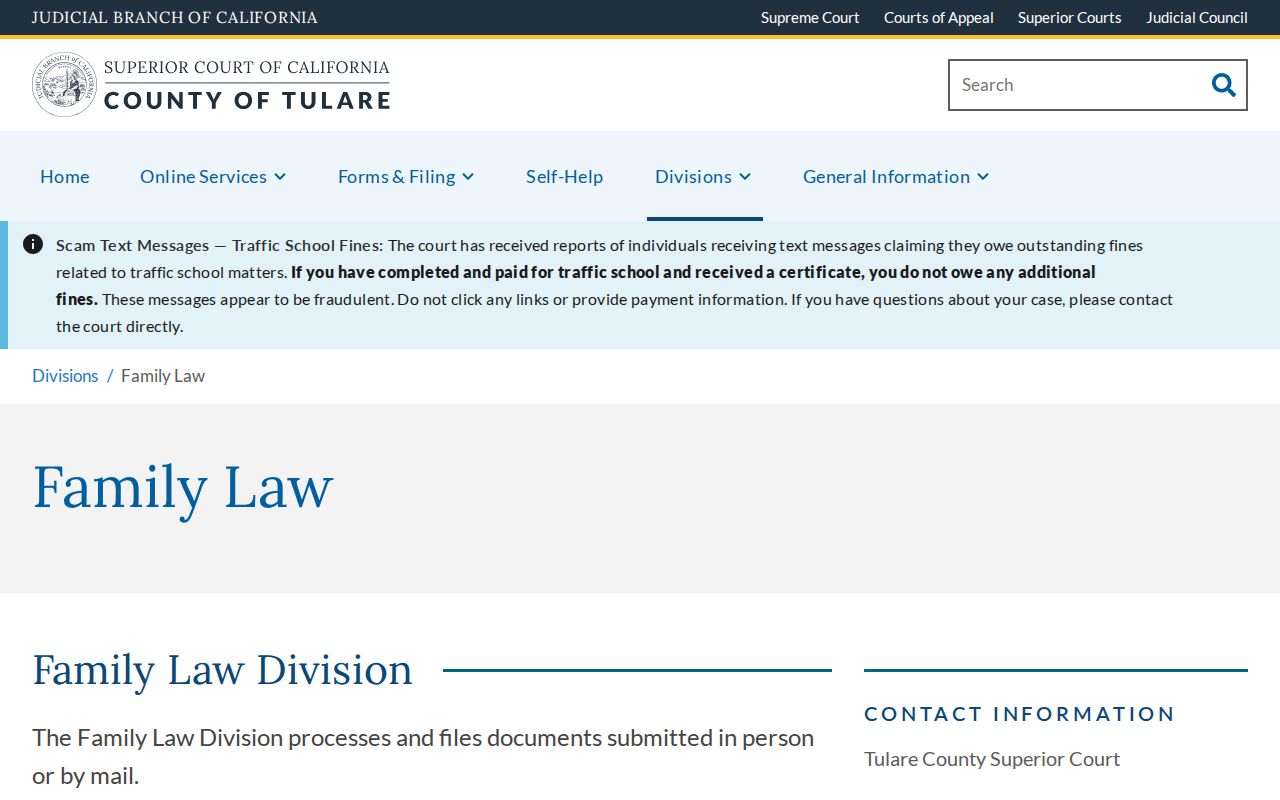
Court access can add a formal event or relationship clue, but public indexes do not display every protected filing.
Visalia Past Households and Previous Residents
Previous residents are best described as a chain of dated clues. The owner trail comes from deeds and assessment records. The household layer comes from reverse directories, telephone books, census schedules, newspapers, yearbooks, and obituaries. Use the address, APN, legal description, and date together. If the people change while the parcel remains stable, the records can show a household transition without claiming that every member is known.
Historic work also benefits from the Carnegie-funded free library opened in Visalia in 1904, the joint county and city building opened in 1976, and the Annie Mitchell History Room added in 1983. These institutional changes help explain why directories, microfilm, and local-history files are divided among Visalia, Tulare, the County Historical Society, and the State Library.
House-history boundary. Use past-resident evidence for genealogy, estate work, and personal history. Do not use a dated name or address to stalk, harass, intimidate, or harm a living person.
Explain a Visalia Previous Resident Disappearance
A directory entry can disappear because of death, remarriage, a new surname, military service, an unlisted number, a missing volume, an address change, or a publisher’s exclusion. A deed can change because of a trust, probate, quitclaim, reconveyance, or title transaction rather than a new household. A permit can show work without showing the occupant. Each gap deserves a source-specific explanation.
Keep a research ledger with the source, exact date, address form, APN or legal description, result fields, image or reel reference, and unresolved question. That ledger makes a later shelf-list request or custodian inquiry precise. It also prevents a plausible story from turning into an unsupported fact.
Note: The best past-residents narrative states what the record shows, what it suggests, and what remains unknown.