
Visalia Directory Collections by Year
The strongest starting point is a coverage table, because the local collections do not all do the same work. A city directory can name a resident or subscriber. A newspaper can add a death, move, business, or social notice. A Sanborn map can establish a building and street footprint. A census schedule can show household members for a particular enumeration year. Treat each as a layer rather than a substitute for the others.
| Collection | Years or publisher | Where held | Access and use |
|---|---|---|---|
| Visalia city directories | Exact run not published online | Annie Mitchell Room; California State Library | Request shelf list; search name or street |
| Visalia and Tulare telephone books | Cataloged by place; exact run needs query | State Library and local history rooms | Useful when a city-directory year is missing |
| Visalia Daily Delta and Morning Delta | 1892-1928 | Tulare genealogy room | Microfilm for obituaries, notices, and addresses |
| Visalia Times-Delta | 1928 to current title history | Libraries and newspaper holdings | News, property notices, and community events |
| Federal population census | 1850-1950 public as of 2026 | NARA, libraries, FamilySearch | Pair enumeration district with address clues |
| Visalia Sanborn maps | 1885, 1888, 1891, 1898, 1913, 1922 sets | Library of Congress | Building footprint and street scheme |
| School yearbooks | Varies by school and title | Annie Mitchell and Tulare genealogy room | Names, photos, activities, and class clues |
Exact city-directory publishers and continuous years remain a documented research gap. Ask for the shelf list before claiming that a missing year never existed. The catalog can lead to a volume even when a search engine cannot expose its pages.
Ask for Visalia Directory Shelf
The Annie R. Mitchell History Room is at the Visalia Branch, 200 W. Oak Avenue. It preserves Tulare County and San Joaquin Valley history and offers historical microfilm, yearbooks, newspaper access, a research-request form, and staff research as staffing permits. The room is open Tuesday through Friday from 1 to 5 p.m.; the History Room phone is (559) 713-2727. Give staff the surname, spelling variants, street or address, occupation, spouse, school, and exact date range.
The History Room research page is an access channel, not proof that the whole collection is digitized. A request may take days to weeks. If a person is absent from a web result, ask whether a print volume, microfilm reel, vertical file, or newspaper index carries the clue. The room’s local knowledge can also point to the nearby Tulare genealogy collection.
The Visalia Branch information page supplies the branch location and institutional context for an in-person directory search.
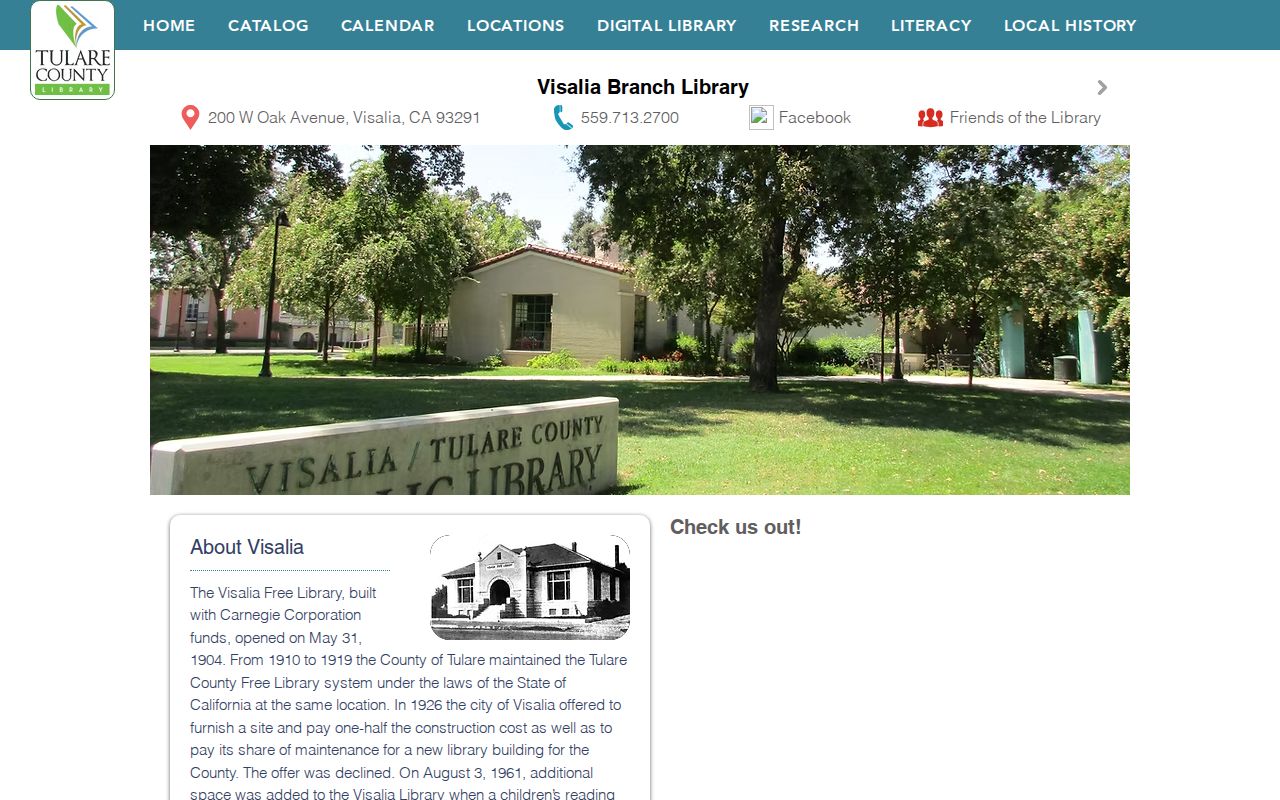
The branch is the local handoff between a catalog search and a physical volume, microfilm reel, or staff research request.
Visalia’s Second Historical Collection
Nearby Tulare Public Library’s Hillman Family Library of Local History and Genealogy is a valuable second channel. The room holds more than 7,000 reference volumes, a California collection, the Hyde II collection, census sources, city and phone directories, surname files, cemetery indexes, county birth, death, and marriage material, microfilm equipment, and Ancestry Library Edition. The Sequoia Genealogical Society supports the collection and responds to inquiries.
The room is at 475 N. M Street in Tulare and is open Tuesday through Friday from 1 to 5 p.m.; its phone is (559) 685-4518. Its documented Visalia Daily Delta and Visalia Morning Delta microfilm reaches 1892 through 1928. This is important when a city-directory entry is missing because a newspaper may publish a marriage, obituary, sale, legal notice, arrival, or address that fixes a person in time.
The collection is regional by design. A Visalia search limited to the city branch can miss a Visalia newspaper reel or donated surname file held in Tulare.
Visalia Staff Directory and City Collections
The City of Visalia’s searchable staff directory is useful when the name belongs to a public official or department contact. Its fields include category, first name, and last name, and results can provide a published department, phone, and organizational entry. It is not a resident roll and should not be confused with a historical city directory.
The Visalia staff directory is the municipal contact source for that narrower question.
The distinction matters: a public employee contact can be verified through the City, while a household entry belongs to the library and historical record trail.
Reading a Visalia Directory Entry
A historical city directory entry is a compact record with publisher-specific shorthand. The safest reading practice is to copy the entry exactly, including punctuation and initials, then consult that volume’s abbreviation key. Do not turn a missing spouse, boarder, or child into a claim that the person was absent from the household.
| Entry element | What it may tell you |
|---|---|
| Surname and given name | The alphabetical name key, often with initials or a spouse in parentheses. |
| Occupation or employer | A work clue that helps separate same-name entries. |
| Home address | The listed street and number for that directory year. |
| Abbreviation | Terms such as “wid,” “r,” “h,” “bds,” or “emp,” if that volume uses them. |
| Reverse entry | Street and number order that can show an occupant or subscriber. |
- Criss-cross directory
- A reverse listing arranged by street and house number.
- Householder index
- A name or household key that may identify the main listed resident, not every member.
- Abbreviation key
- The publisher’s explanation of short forms used in that volume.
- Subscriber
- The person or household attached to a listed telephone account, which may not equal an owner.
Owner or renter marks vary by publisher and year. Compare an apparent owner with the county deed or tax record. Compare an apparent occupant with a newspaper, census, or later directory before drawing a family conclusion.
Visalia Reverse and Telephone Directories
Alphabetical pages answer “where was this name listed?” Reverse pages answer “who was listed at this number?” Telephone books add a third variation: subscriber and phone. The State Library’s Visalia research guide directs searches to both its City Directories database and Telephone Books database, using “Visalia” and “Tulare.” Residential listing exclusions and publication gaps mean that a telephone book cannot stand in for a complete resident roll.
Reverse pages are especially useful for a house-history question. Copy the street, number, name, spouse notation, occupation, and nearby entries. Then compare the same number in the next available volume. When a street number shifts, use a Sanborn sheet, subdivision map, APN, or legal description to test continuity. The California State Library Visalia research guide also points toward newspapers, maps, county histories, census material, and manuscript sources.
Note: A listed subscriber is evidence of a published connection, not proof of present occupancy or ownership.
Trace a Visalia Directory Household
Begin with a known address and year. Copy the entire name entry and every same-surname entry nearby. Move one directory year at a time, using the reverse section to find replacement occupants. Bridge missing volumes with telephone books, newspaper notices, census schedules, voter or poll material where lawfully accessible, deeds, permits, obituaries, and probate. Keep the street number and the legal property key in separate fields because they may drift.
- Anchor the first entry with its full address, publisher, volume year, and page or reel reference.
- Check the next available year for the same name, spouse, occupation, and nearby addresses.
- Pair a 1950-or-earlier address with the matching federal census enumeration district and schedule.
- Use the Recorder’s legal description or APN to test whether an owner change explains the new household.
- Use an obituary, probate case, or newspaper notice to explain a disappearance before calling it a move.
A person may vanish because of death, remarriage, a new surname, military service, an unlisted number, a directory gap, or a publisher rule. A continuous narrative needs corroboration, not smooth prose.
Pair Visalia City Directories with the Census
Federal population census schedules from 1850 through 1950 are public as of 2026. The census can add household members, ages, birthplace, occupation, and, depending on the year, tenure or value. Match the directory address to the enumeration district, street order, names, and neighbors. A census date is not the same as a directory date, so allow for the months between them.
Names can be indexed with initials, spelling differences, or OCR errors. Compound Spanish surnames, omitted accents, married and maiden names, and reversed name order deserve deliberate tests. Never infer ethnicity or relationship from a surname alone. The 1891 Visalia Sanborn map can establish the early building and street footprint before the documented 1892 newspaper run, but it does not name every resident.
Use Sanborn for Visalia Directory History
The free 1891 Visalia Sanborn atlas contains ten sheets. It shows building footprint, construction material, use, street labels, and block form. Later verified sets include January 1885, March 1888, April 1898, January 1913, and May 1922. These maps answer whether a structure or street arrangement existed in a period. They do not identify every resident, and a map label should not be mistaken for an address register.
For house history, pair the map with a reverse directory, newspaper, census schedule, and Recorder legal description. If the map’s old number does not match a later number, preserve the discrepancy and seek a subdivision map or directory street guide. The full property trail belongs with the parcel and deed, while the map supplies a historic geographic baseline.
Visalia Directory Clues in School Yearbooks
Yearbooks are a companion to the Visalia city directory when the search concerns a classmate, school friend, or local family. The documented inventory includes Divisadero Junior High’s Acorn from 1959 to 1986 with gaps, Green Acres Logette in selected years, Mt. Whitney Oak from 1955 to 1968 and later scattered volumes, Redwood Log from 1956 to 1982 plus later volumes, and a Visalia Union High graduate list from 1891 to 1934. Visalia Junior College Tartar runs from 1930 to 1949 except 1944, while College of the Sequoias Koh-Kyo runs from 1951 to 1980 with gaps.
Use a yearbook name, photograph, class, club, or activity as a lead. Confirm the person with a newspaper, directory, obituary, deed, or official record. A school appearance does not prove a home address in that same year, and later pages may be held by the school or library rather than a searchable public portal.
Missing Visalia City Directory Entries
A blank in a Visalia city directory can have many causes. A volume may have an unverified gap. A person may have declined a telephone listing, changed a surname, moved between publication dates, lived in a household listed under another name, or been omitted by the publisher. A scan may be unavailable even when a paper volume exists. A failed search is a prompt for the shelf list, not an answer about a person’s life.
History Room staff, the State Library, the Hillman room, the Historical Society, and local newspaper holdings provide different access channels. The History Room also offers obituary research for San Joaquin Valley Library System-area residents and asks outside-area requesters for a donation of $3 or more per obituary. If the death date is unknown, staff searches no more than seven days after the death date supplied or inferred.
Note: Keep a source log that says whether a result came from an index, image, microfilm, staff search, or user-contributed memorial.