
How Visalia Residents Are Found
A useful Visalia residents directory search follows the evidence instead of treating one name hit as a complete answer. The Tulare County Assessor and GIS layers connect a street address to an assessor parcel number, or APN. The Recorder then supplies the recorded name trail. A court case, state license, business filing, obituary, or library directory can add a second identity anchor. Each source answers a different question. An owner record may show a mailing address, while a city directory may show a listed occupant from another year.
Start with the clue that is least likely to change. A full address is often stronger than a common surname. A middle name, spouse, school, case number, date range, or legal description can prevent a false match. Older Visalia work usually needs more than a portal because online coverage is uneven and many records are indexes rather than images.
- Normalize the name or address, including directional words, initials, accents, and spelling variants.
- Use the county parcel and assessment tools to separate the situs address from the owner mailing address.
- Follow the Recorder’s grantor and grantee names, then compare the APN or legal description.
- Check the Tulare Superior Court index, a state affiliation source, or an authorized vital-record route when the question calls for it.
- Move to the Annie R. Mitchell History Room, Tulare genealogy room, newspapers, census schedules, or a narrow records request when the online trail ends.
That sequence supports family history, house history, reconnecting, and careful civic research. It does not turn the public record into a complete household list.
Visalia Records Offices at a Glance
Visalia is both a city and the Tulare County seat, so several record channels sit around the County Civic Center at 221 S. Mooney Boulevard. The Tulare County Assessor/Clerk-Recorder keeps recorded land instruments and county certificates. The Recorder is in Room 103 at (559) 636-5050, and the County Clerk is in Room 105 at (559) 636-5051. Counter hours are Monday through Friday, 8 to 5, with filing and certificate issuance generally handled from 8 to 3.
The Assessor connects an address to a parcel and assessed value, but an owner is not automatically an occupant. The County Clerk handles birth, death, marriage, fictitious-business-name, and notary records. The Superior Court handles civil, criminal, family, probate, and traffic matters because Visalia has no separate municipal court. The County Law Library is in the courthouse basement, Room 1, and is a reference stop for statutes, forms, and case research rather than a resident file keeper.
Recorder and County Clerk
221 S. Mooney Blvd., Rooms 103 and 105
Visalia, CA 93291
(559) 636-5050 / (559) 636-5051
Tulare Assessor and GIS
County property and parcel services
APN and situs-address search
County hub and live portal
For city-held permits, code files, planning records, or departmental records, the City Clerk accepts a request through the city portal, by email, mail, or in person. The California Public Records Act, or CPRA, governs existing disclosable records. It does not require the City to create a new list of residents.
The Visalia public-records request page shows the city route for existing municipal files.
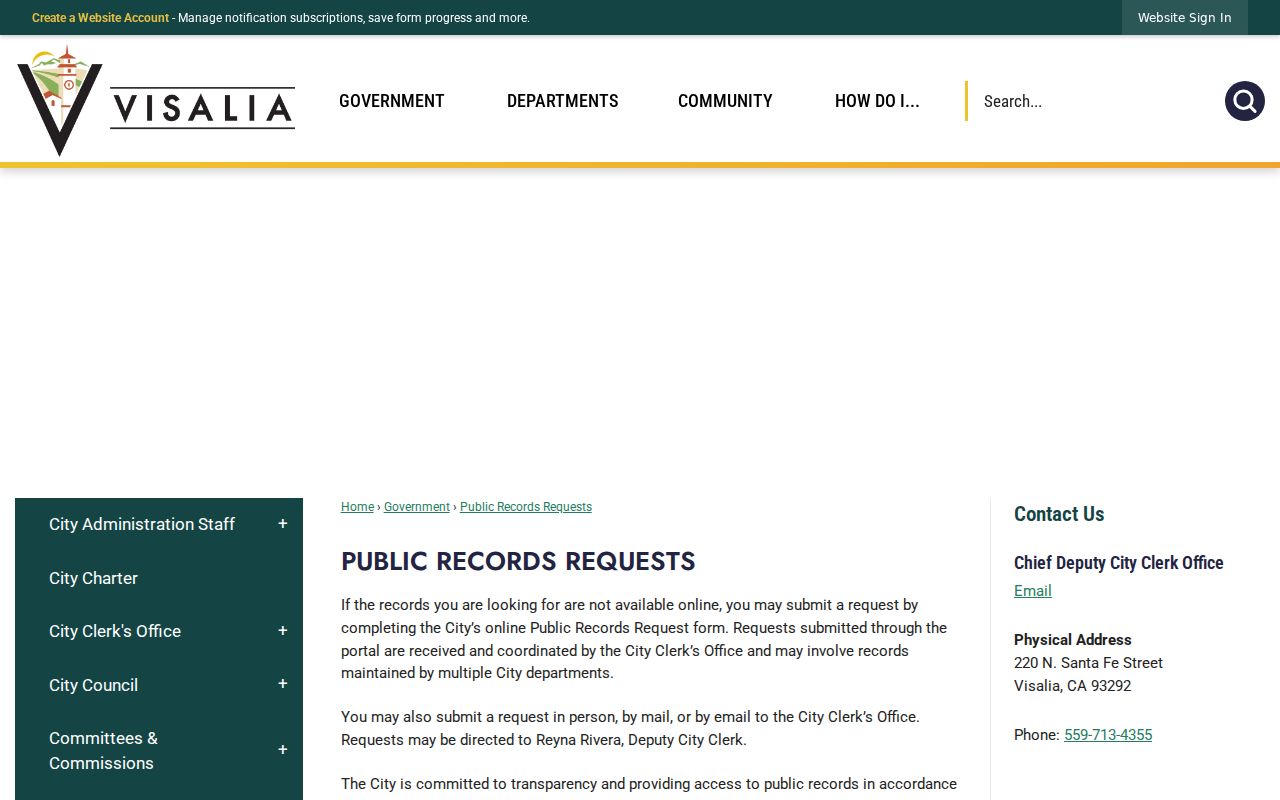
The city request channel is useful when a permit or code record exists but its online status view does not answer the address question.
Visalia Resident Trail from an Address
The address chain begins in the county parcel tools. The county-authorized ParcelQuest search accepts an APN or street address. The GIS catalog and public parcel layer add map context, boundaries, lot or block references, and links to property information. Use the physical, or situs, address for the parcel. A tax mailing address may belong to a post office box, trust, manager, or another property. It can be a useful contact clue, but it does not prove that the owner lives at the parcel.
Once an APN and owner name are available, the Recorder’s index can be searched by party name, document number, and document type. A deed index is a card-catalog style guide, not the deed itself. Record the grantor, the person transferring an interest, and the grantee, the person receiving it. Then compare the recording number, date, legal description, and APN. Addresses can be missing or later changed, so the legal description is the stronger bridge for a historic chain.
| Parcel clue | What it can establish |
|---|---|
| APN | The county’s stable parcel identifier for map and assessment work. |
| Situs address | Where the land or structure is physically located. |
| Mailing address | Where tax correspondence is sent, not proof of residence. |
| Legal description | Subdivision, lot, block, or survey language used in recorded instruments. |
Liens, deeds of trust, reconveyances, and quitclaims need careful labels. A lien is a claim against property. A deed of trust secures a debt and does not by itself transfer title. A reconveyance releases that security interest. A quitclaim may change an interest without a normal sale. Treat the document type as evidence about a transaction, not a direct statement about who lived there.
Visalia Records in the Recorder Index
The Tulare recorded-document index offers an online starting point, but the public instructions do not publish a definitive online start year, result cap, or complete document-type list. Search every spelling variant. Older names may be indexed exactly as presented, and the grantor or grantee role can change how a result appears. Military-discharge papers and legally confidential data do not have the same open access as ordinary deeds.
| Search field | Type | Use |
|---|---|---|
| Name | Text | Try surname, given name, initials, and spelling variants. |
| Document number | Text | Retrieve a known recorded instrument directly. |
| Document type | Filter | Narrow the live result set; the full menu must be checked in the current interface. |
| Other search criteria | Portal-dependent | Use only fields the current county interface exposes. |
Copies can be obtained online after the index search, at the Room 103 counter, or through a mailed Recorded Document Request Form. Uncertified online copies are immediately downloadable after payment; the county lists $3 for the first page and $1 for each additional page, with certification at $2 per document. In-person visitors can pay by cash, check, money order, or card. Mailed requests use check or money order, never cash.
Note: The county recommends trying every spelling variant because an index search does not correct a name to the form a researcher expects.
Current Visalia Resident Sources
A current Visalia residents directory is really a set of partial rolls. The Assessor shows property ownership where displayed. The Recorder shows parties to recorded instruments. My Voter Status is a self-lookup for a matched voter, not a public name-and-address directory. The City staff directory lists public employees and departments, not city residents. State license, business, and unclaimed-property tools show affiliations that may help confirm a person, but each address must be labeled as a business, agent, mailing, or premises address.
| Source | What it lists | Keeper | Access idea |
|---|---|---|---|
| Assessment roll | Assessee, APN, situs and mailing clues | Tulare Assessor | Parcel search or counter |
| Recorded-document index | Grantors, grantees, liens, maps | Recorder | Free search, paid copies |
| Voter status | One matched voter’s status and ballot details | California Secretary of State | Identity-gated self-lookup |
| Staff directory | Published City names and phones | City of Visalia | Free online search |
| Business or license index | Entity, license, agent, or premises ties | State and county offices | Official affiliation clue |
The safest match uses two independent anchors, such as an APN and deed plus a known timeframe, or a court party and an associated person. A name and city alone are too thin in a community of more than 146,000 people. For a one-person workflow, move to the Visalia resident lookup path after identifying the question the record can answer.
Tulare County’s public-records request portal is a countywide fallback for an existing record that is not exposed in a smaller search interface.
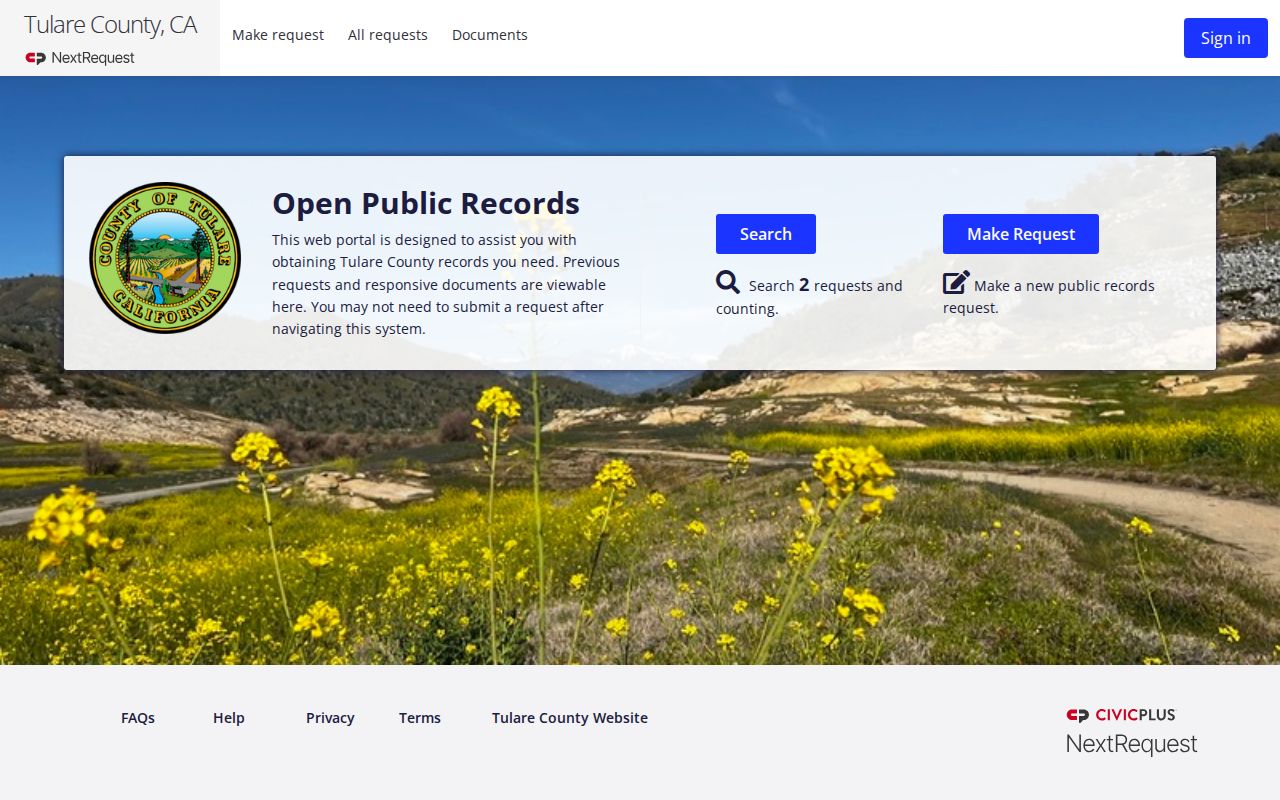
A request still has to name an existing record and cannot compel the County to create a resident list.
Visalia Voter Lookup Is Not a Directory
California’s My Voter Status tool asks for a first name, last name, date of birth, and, when prompted, a California driver license or ID number or the last four digits of a Social Security number. It returns the matched voter’s registration status, party preference, polling place, vote-by-mail or ballot status, and election information. Those identity fields are used to match a person and are not public result fields.
Tulare County voter data requests are governed by Elections Code sections 2187, 2188, and 2194. Street address, phone, driver-license or ID number, and precinct data are not ordinary CPRA disclosures. Candidates, ballot-measure committees, government agencies, and qualifying election, scholarly, journalistic, or political requesters may apply with a wet signature, a detailed purpose, a data scope, and a security plan. Misuse can carry a $0.50 per-record penalty. A casual street search should stop here rather than treat a protected file as a neighbor list.
Practical boundary. A voter-status result belongs to the matched voter. It should not be copied into a public resident roll or used to infer every household on a Visalia block.
Visalia Court Records, Searched Carefully
The Tulare Superior Court is the court source for Visalia cases. The homepage routes to Case Search, while the vendor interface and field labels can change. A case number is the most precise key. A party or defendant name, citation number, case category, date, or calendar can narrow the search. Civil, criminal, family, probate, and traffic matters may appear, but juvenile, adoption, sealed, and other confidential records are excluded or redacted.
| Result field | Why it matters |
|---|---|
| Case number and title | Separates one matter from another same-name hit. |
| Filing date and category | Tests whether the time and case type fit the person. |
| Hearings and events | Shows public docket activity without promising a filed image. |
| Status or disposition | May describe the public outcome; it is not a full case file. |
Use a middle name, known associate, location, or time window before treating a name hit as a match. The clerk can explain retrieval and copying. Federal matters for Tulare County run through the Eastern District of California and PACER, which returns federal docket data through an account and charges standard electronic access fees.
Recent court messages also illustrate why direct verification matters. Tulare Superior Court has warned about fake traffic-school fine texts. Do not click a payment link in an unexpected message. Confirm through the court’s official phone number or case portal.
The Tulare Superior Court homepage is the source for the Case Search entry point and current notices.
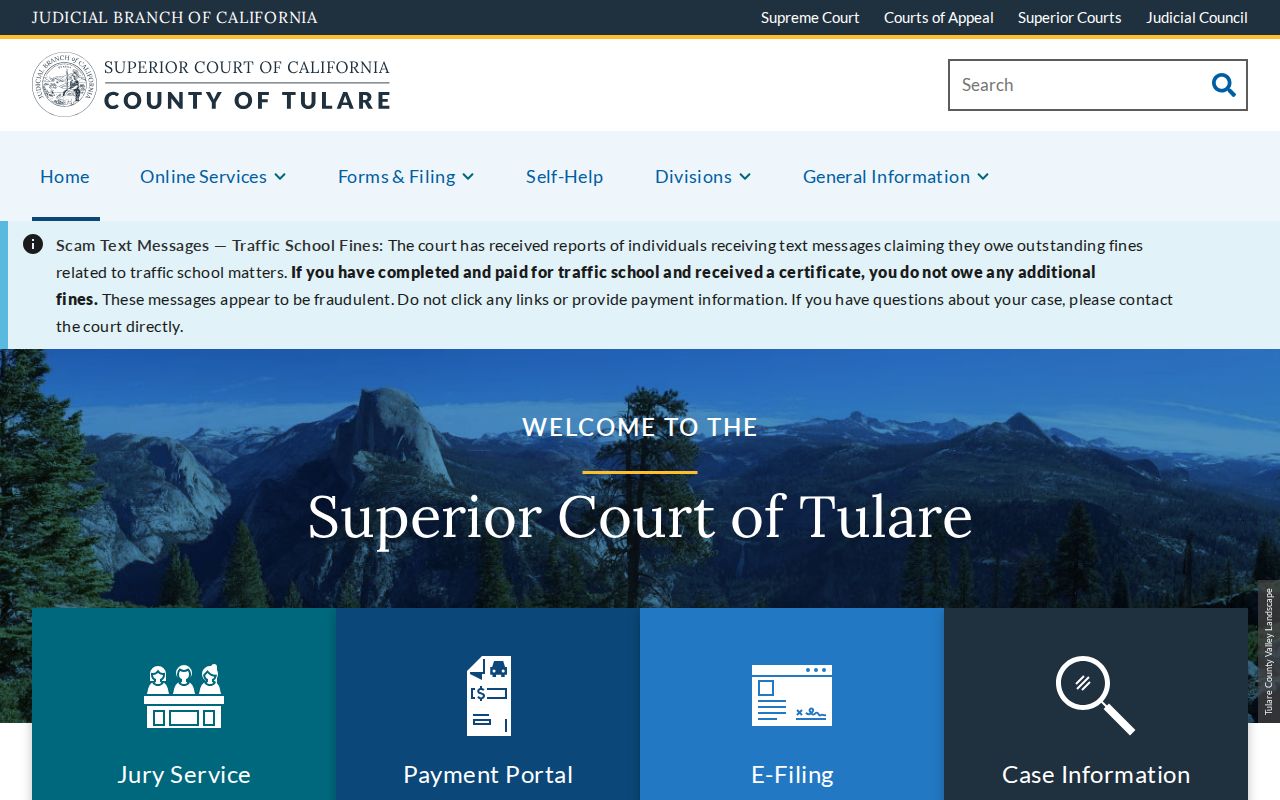
The court image is an orientation aid; the clerk controls access to filings, certified copies, and protected case material.
Visalia Resident Records: Certificates and Clues
Tulare County Clerk-Recorder certificates cover county births, deaths, and marriages. Certificate images are not openly displayed online. For records from 1998 to the present, the county says in-person copies can generally be produced the same day. Pre-1998 requests are generally ready the following business day. An authorized copy requires a qualifying relationship and, for mail, a notarized sworn statement. An informational copy may be available more broadly, but it carries a legend and cannot establish identity.
California Health and Safety Code sections 103525 and 103526 distinguish authorized and informational copies. Confidential marriage records and adoption records have special limits. Divorce judgments and full files come from Superior Court, while the California Department of Public Health can provide a certificate of record for qualifying divorce years. Historical birth and death indexes, cemetery records, church registers, and obituaries are useful clues, not replacements for a certified record.
| Question | Best first route |
|---|---|
| Did a county event occur? | Tulare County Clerk-Recorder application. |
| Can a relationship be proved? | Authorized-copy eligibility and identity declaration. |
| What happened in a divorce? | Superior Court docket and judgment request. |
| Is there an older death clue? | Obituary, cemetery, newspaper, or historical index. |
The California Attorney General’s CPRA overview explains the statewide public-records framework behind these request routes.
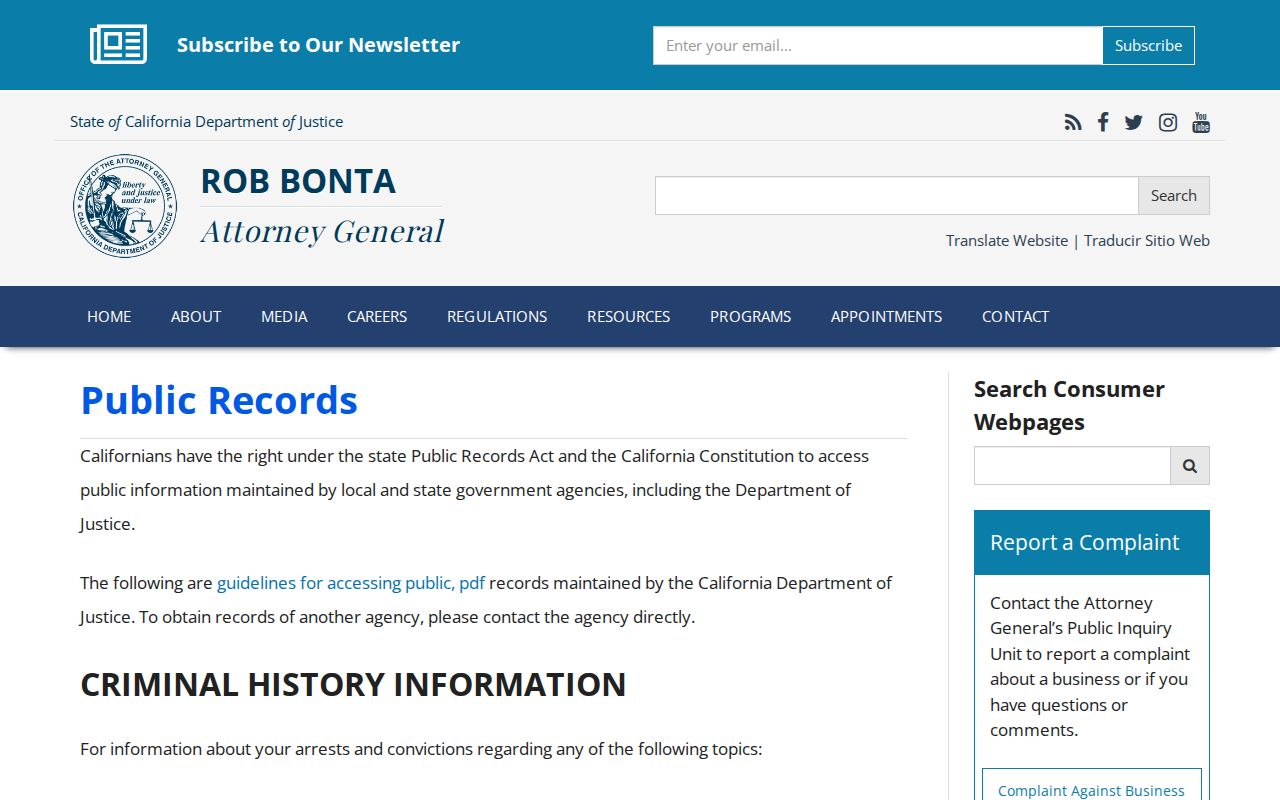
The state overview reinforces the distinction between inspecting an existing record and asking an agency to build a new list.
Visalia City Records Through the Clerk
City records can add a street address, applicant, contractor, project date, or planning context when the county roll does not answer the question. The Visalia Accela permit search accepts an application or record number, project name, street number range, direction, street name and type, unit details, and a start and end date. The visible Building search fields are optional, and the inspected page defaulted to a three-year date window. The city warns that an application or contractor is not proof of an occupant.
A permit jacket, final inspection, code file, business-tax registration, planning entitlement, or historic-preservation file may be requested by a narrow address and date range. The City Clerk’s CPRA portal accepts online, email, mail, or in-person requests. The City has ten days to determine whether responsive disclosable records exist, subject to a possible 14-day unusual-circumstances extension under Government Code section 7922.535. Inspection at City Hall is free; duplication and mailing costs may apply. A request should name an existing record, not ask the City to create a resident history.
Note: The permit counter is at City Hall East, 315 E. Acequia, and the public phone is (559) 713-4444; verify current hours before visiting.
Visalia Resident Affiliations in State Records
Some searches answer who a person is connected to, not where that person lives. California’s Department of Consumer Affairs license search can filter by board or bureau, license type, license number, person or business name, and city or county. Secretary of State bizfile Online can show an entity number, status, formation information, agent, principal or mailing address, and filing history. A County Clerk fictitious-business-name filing can connect a trade name to a registrant and business address.
The State Controller’s unclaimed-property search accepts an individual or business name and city. Results can show a reported owner name, reported city, reporting business, and property type or identifier. Search and claims are free through the State. These are affiliation clues. A business premises, agent address, license address, or stale reported location must never be rewritten as a home address.
Label the address. Record whether an address is a situs, mailing, business, agent, premises, or public office address before comparing it with a resident name.
Visalia Historical Resident Records in Libraries
The Annie R. Mitchell History Room at the Visalia Branch, 200 W. Oak Avenue, is the first local stop for old names and streets. It holds historical microfilm, yearbooks, newspapers, photographs, maps, and research-by-request help. The room is open Tuesday through Friday from 1 to 5 p.m.; the History Room phone is (559) 713-2727. Staff asks for full names, spelling variants, an address, and a date range, and answers may take days to weeks.
The nearby Hillman Family Library of Local History and Genealogy in Tulare holds more than 7,000 reference volumes, county indexes, city and phone directories, census material, surname files, and Ancestry Library Edition. Its documented Visalia Daily Delta and Visalia Morning Delta microfilm run reaches 1892 through 1928. The California State Library’s Visalia research guide points to city-directory and telephone-book databases, Sanborn maps, newspapers, county histories, census, and manuscript material. Search both “Visalia” and “Tulare” because the collection is regional.
The shelf is especially useful when a property record names an owner but not a household. A reverse directory can put an occupant at a street number. A newspaper notice can connect a death, marriage, business, or move to an address. A yearbook can confirm a school and year. None of these clues should be treated as complete when a person was unlisted or a volume has gaps.
The City’s history of Visalia provides the local chronology behind the county-seat and downtown record geography.
The county-seat history helps explain why court, deed, library, and administrative clues cluster around the Civic Center.
The Annie R. Mitchell History Room source describes the local microfilm, yearbooks, newspaper access, maps, and research-request channel.
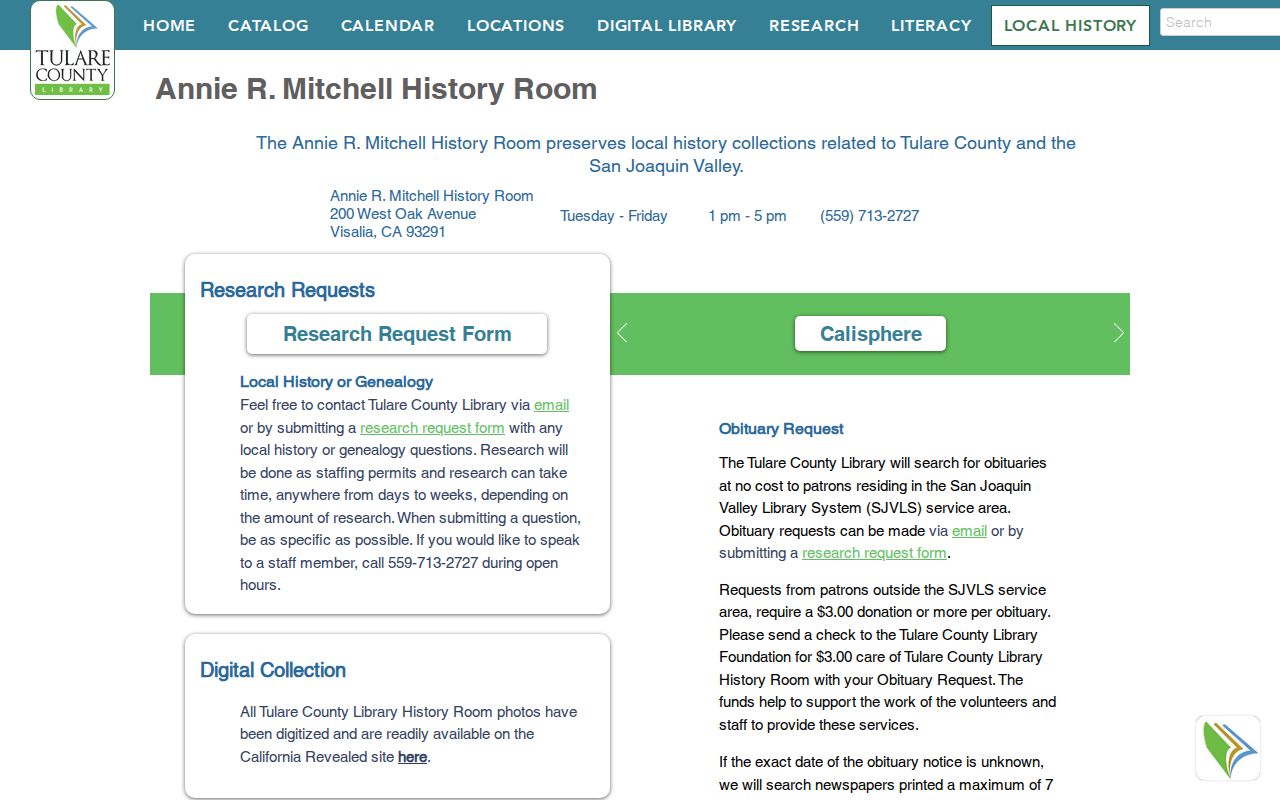
The History Room is the human-assisted fallback when a directory or newspaper clue is not exposed by a web search.
Visalia ZIP Records and Delivery Areas
ZIP geography gives a broad first cut, not a household list. USPS delivery routes use postal boundaries that can cross city, council, parcel, and county lines. The Visalia ZIP code directory includes three broad street-delivery codes and two PO-box or legacy postal contexts. A “Visalia” postal city does not prove that a parcel sits inside the municipal permit jurisdiction.
| ZIP | Documented role | Reading caution |
|---|---|---|
| 93277 | Central, south, and west Visalia street delivery | Crosses neighborhood, council, and parcel boundaries. |
| 93291 | North, northwest, and parts of central delivery | Includes Civic Center mailing addresses and growth areas. |
| 93292 | East and southeast street delivery | May include county or unincorporated edges. |
| 93278 | Visalia PO boxes | Not a residential neighborhood. |
| 93290 | PO boxes or legacy postal context | Verify each address rather than mapping it as an area. |
Verify an address-to-ZIP match through the USPS ZIP lookup. Verify city limits and permit custody with the City GIS or county parcel record. Assessor and permit portals primarily search addresses or APNs, not reliable ZIP-wide resident lists. The Visalia ZIP code directory page carries the ZIP-by-ZIP workflow.
Visalia Records and Privacy Rules
California records are not equally open. The Safe at Home program gives qualifying victims and specified reproductive-health participants a substitute mailing address and mail forwarding. Voter identifiers and use are restricted by Elections Code section 2194. DMV personal information is protected under the federal Driver’s Privacy Protection Act. Vital, court, police, marriage, adoption, and recorded-document systems each have their own redaction or access rules.
Commercial compilers may copy public fragments, but a paid result is not more authoritative than the custodian’s record. If a commercial listing is wrong, the originating assessor, Recorder, court, Clerk, or State office is the place to correct the source. California’s Consumer Privacy Act and Delete Act can affect covered businesses and data-broker suppression, but they do not erase lawful county deeds or court records.
Note: A missing person from a public result may reflect a protection, an unlisted entry, a redaction, or a record that never existed in that system.
Verify a Visalia Resident Record
A good Visalia residents directory result ends with verification, not a confident guess. Compare two independent sources and write down the custodian, retrieval date, search terms, and the exact type of address shown. For a property question, pair an APN and deed with a known date. For a court question, pair the party name with a case number, category, and associated timeframe. For family history, pair an obituary or directory clue with a certificate, newspaper, probate file, or cemetery record.
Correct errors at the source office. The County Clerk, Recorder, Assessor, Elections office, Superior Court, City Clerk, or state agency can explain its record and correction process. A phone call may clarify where a file lives, but clerks generally will not certify that a name hit is the person a researcher has in mind. Keep protected records protected and use public contact channels rather than trying to expose a private address.
Visalia Record Scams to Check Directly
Record research creates openings for copy-order and payment scams. A deed-copy solicitation may use a real parcel number but charge a large markup. The Recorder’s own online, counter, and mail routes are the safer starting points. Property-fraud signs include an unexpected deed, mortgage paper, or tax-bill change. Tulare guidance directs people to check the official portal and contact local police or the District Attorney’s Bureau of Investigations at (559) 636-5410 when fraud is suspected.
Unclaimed-money finder fees are unnecessary because the State Controller provides a free search and claim route. Obituary-driven family emergencies should be confirmed through a known family number. Court or traffic texts that demand payment should be checked with Tulare Superior Court at (559) 730-5000. These checks protect both the record trail and the person being researched.
| Concern | Direct check |
|---|---|
| Deed or title solicitation | Recorder, (559) 636-5050. |
| Suspected property fraud | Visalia Police and Tulare DA investigations. |
| Traffic or court text | Tulare Superior Court’s official portal and phone. |
| Unclaimed property fee | State Controller search and claim process. |
Where Visalia’s Older Resident Rolls Survive
Historical Visalia resident directories begin with a shelf request, not an assumption that every year is online. The Annie Mitchell Room and California State Library catalog city directories, telephone books, reverse or criss-cross directories, newspapers, maps, and county histories. Exact publisher runs are not exposed in the inspected catalog text, so request a shelf list for the surname, street, and years at issue. The fuller collection guide belongs on the Visalia city directory page.
Pair a directory with the 1891 Sanborn atlas, which contains ten sheets of Visalia building and street evidence, and with the documented 1892 to 1928 newspaper microfilm. The map can establish a building footprint and street label but does not name every resident. Census schedules, deeds, permits, obituaries, and probate can then explain who occupied or owned the place across time. A missing directory entry may mean a gap, an exclusion, a move, a death, a name change, or a publication rule. It is not proof by itself.
When a shelf or online index stops, state archive catalogs, library reading rooms, family-history catalogs, and federal archive holdings provide the next channels. Note: Older Visalia records are strongest when the address, legal description, directory entry, and date are kept together as one evidence chain.